Beautiful wood floors add warmth and value to your home, but keeping them looking brand new requires the right approach. Proper hardwood floor maintenance comes down to four simple habits: removing daily grit, cleaning with a pH-neutral product designed for your specific finish, holding indoor humidity between 30% and 50%, and recoating every three to five years before the protective seal wears completely through.
If you skip the steam mops, avoid vinegar, and never apply wax over polyurethane, a well-sealed floor will look sharp for decades. The secret to long-lasting floors is knowing exactly what goes into your mop bucket. That is why we highly recommend using a dedicated system for your routine. You can find our trusted pH-neutral cleaners, restorer formulas, and washable mop pads in our Bona Floor Care & Finishes collection.
As a locally owned supplier in Clemmons with over 20 years of experience, we understand exactly what it takes to keep your home looking flawless. Are you ready to protect your beautiful investment and avoid costly repairs down the road? Let the friendly experts at Floor Plus More, Inc. equip you with the perfect care routine. Contact us today or stop by our showroom to speak directly with our team, and let us help you find the exact products your floors need to last a lifetime.
Hardwood Floor Maintenance Schedule at a Glance
At Floor Plus More, Inc., we find that households actually keep up with this routine because every task below takes under 30 minutes.
Task
Frequency
Tool
Time
Dust mop or sweep
Daily
Microfiber dust mop
5 min
Bare-floor vacuum
Weekly
Vacuum, brush roll off
15 min
Damp clean
Monthly
pH-neutral cleaner, microfiber mop
30 min
Humidity check
Weekly, November to March
Hygrometer
1 min
Felt pad check
Twice a year
Replacement felt pads
20 min
Water-drop test
Yearly
Dropper or spoon
10 min
Recoat
Every 3 to 5 years
Flooring contractor
1 to 2 days
Know Your Finish Before You Clean
While exploring the different types of hardwood flooring—like solid oak versus engineered planks—is crucial for your home’s design, knowing the exact finish on top of that wood is the secret to proper cleaning. Surface-sealed floors wear a clear urethane film, and most factory-finished boards fall here. Penetrating-oil floors soak finish into the wood, and waxed floors carry a paste layer that needs dry buffing. Each type needs different hardwood floor care, so identify yours first.
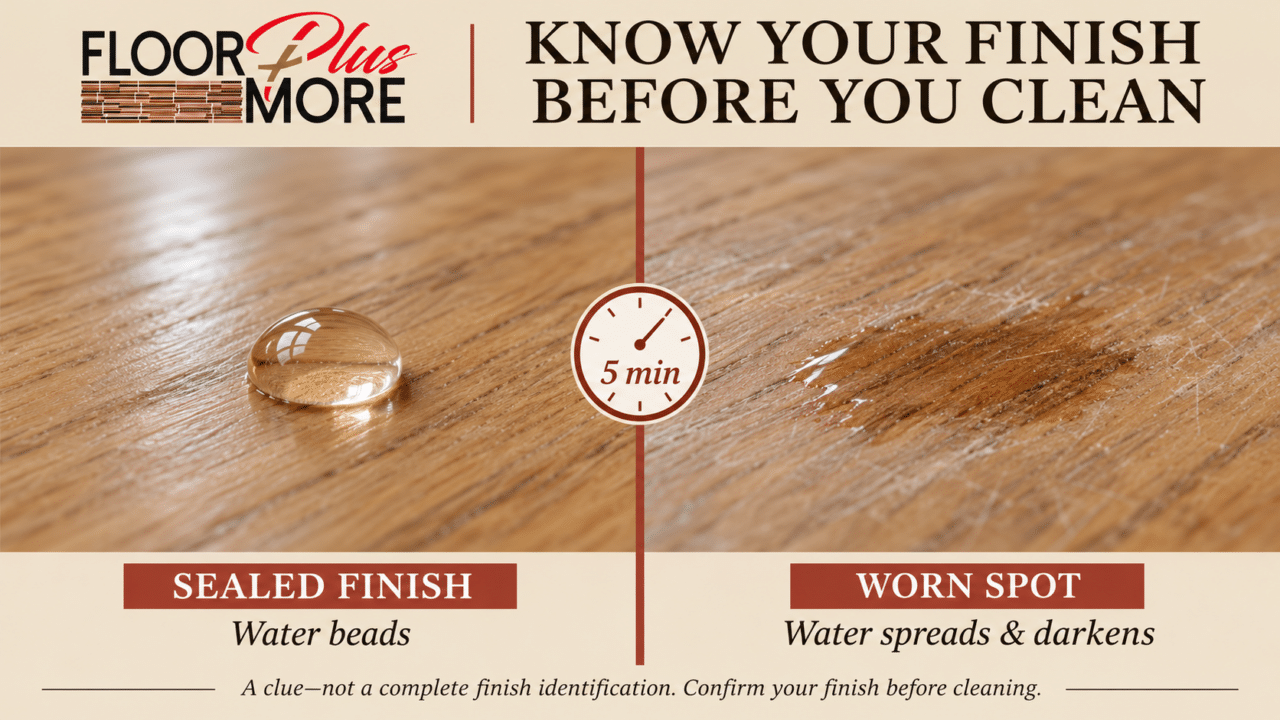
The Water-Drop Test
Place one drop of water on a clean spot and wait 5 minutes. A round bead means a surface seal. A drop that darkens the wood within 1 to 2 minutes points to oil, wax, or a worn finish.
Prefinished and Unfinished Floors
Boards from our prefinished hardwood flooring range ship with a highly durable, factory-cured finish, so the cleaning plan below applies right away. On the other hand, unfinished boards are installed as raw wood and finished in your home. For these site-finished floors, the right cleaning method depends entirely on the specific product applied, so always keep the finish can label or your contractor’s invoice on file.
What Is the Best Way to Clean Hardwood Floors?
When it comes to the best way to clean a hardwood floor, your first step should always be clearing away loose dirt and grit using a dry sweeper or your vacuum’s hard-floor setting. Once the surface is completely free of debris, follow up with a lightly moistened microfiber pad and a pH-neutral cleaner formulated specifically for your wood finish. Always glide your mop in the same direction as the wood grain, and make sure to wipe up any lingering wet spots within a minute to keep moisture from seeping into the seams.
How to Clean Hardwood Floors in 5 Steps
Clear the floor (2 minutes). Move rugs, chairs, and toys so you can mop in long, unbroken passes.
Remove grit first (10 minutes). Use a dust mop or a vacuum on its bare-floor setting. Grit dragged under a wet pad works like sandpaper.
Apply cleaner to your mop head, never the wood (1 minute). Spritz the cleaning solution directly onto the microfiber cloth so that it becomes slightly moist, making sure it never reaches the point of dripping.
Mop with the grain (15 minutes). Work in 4-foot by 4-foot sections and flip the pad when it turns gray.
Check for puddles (2 minutes). Look across the room toward window light. Shiny streaks mean too much liquid, so towel them dry.
Spills, Sticky Spots, and Pet Accidents
Blot spills right away with a dry cloth. For sticky spots, press a cloth dampened with your cleaner on the spot for 30 seconds before wiping. Pet accidents need the fastest response, because urine can seep through a seam and darken the hardwood flooring beneath the finish.
So What Do I Clean It With? Safe Product Types for Sealed Floors
Four product types cover nearly every situation, and none of them needs a long shopping list.
pH-neutral cleaner: A formula near pH 7 lifts dirt without etching urethane. Choose one labeled for hardwood.
Refresher: This restores sheen between recoats by filling hairline scratches. It does not replace a recoat.
Microfiber mop: A flat mop with washable pads traps fine dust and uses far less water than a string mop. Wash pads without fabric softener, which leaves a slick film.
Dust mop and bare-floor vacuum: These handle the daily work. Switch the vacuum’s beater bar off.
Here is the angle most guides skip: stay inside one product line. Switching brands or layering oil soap builds a residue that causes haze, and at recoat time that film can interfere with how the new finish bonds. The Bona Floor Care & Finishes range lets you match cleaner, refresher, and mop in one system, and our counter team will help you pick by finish type.
What Not to Use on Hardwood Floors
To protect your investment, strictly avoid steam cleaners, vinegar and water solutions, wax or polish applied over polyurethane, oil-based soaps, ammonia, bleach, and dripping-wet mops. Every item on this list will either force moisture deep into the board seams, permanently etch the protective layer, or leave behind a stubborn residue that makes future recoating impossible.
Product
What it does
Safer swap
Steam mop
Steam above 212°F pushes moisture into seams
Damp microfiber pad
White vinegar and water
Vinegar sits near pH 2.5 and dulls urethane over time
pH-neutral cleaner
Wax or polish on polyurethane
Leaves hazy film that resists recoating
Refresher made for your finish
Oil soap
Builds a sticky residue that holds dirt
pH-neutral cleaner
Ammonia or bleach
Strips and clouds the finish
pH-neutral cleaner
Are Steam Mops Safe for Hardwood Floors?
The short answer is NO. Topflooring experts and leading industry authorities strongly warn against using steam cleaners or soaking-wet mops on wood surfaces. The intense heat and vapor force their way into the microscopic seams between boards. As months go by, this trapped moisture will cloud your floor’s protective layer, cause the wood planks to warp or cup, and eventually destroy the urethane bond. Instead, stick to a lightly moistened microfiber pad for safe and effective cleaning.
How to Protect Hardwood Floors Every Day
At Floor Plus More, Inc., we always remind our customers that prevention costs much less than correction. This is how to protect your hardwood floors between cleanings:
Felt pads: Fit every furniture leg that touches the floor, and replace any pad that flattens or picks up grit.
Entryway mats: Place one outside and one inside each entry. Choose breathable fabric, because rubber backing can trap moisture and discolor a finish.
Pet nails: Trim every 2 to 3 weeks.
Sunlight: UV rays fade boards unevenly. Rotate rugs and furniture every 3 to 6 months, and add sheers on west-facing windows.
Heels and cleats: A stiletto focuses a person’s full weight on under 1 square inch, easily denting the wood, so leave them at the door.
Want to make sure you are using the absolute best products to protect your investment? Stop by our physical flooring store to browse our trusted, floor-safe supplies and chat with our experts. We can help you pick out the exact floor care system your home needs. You can easilyget directions to our Clemmons showroom to come see us today!
How Do You Protect Hardwood Floors in Winter?
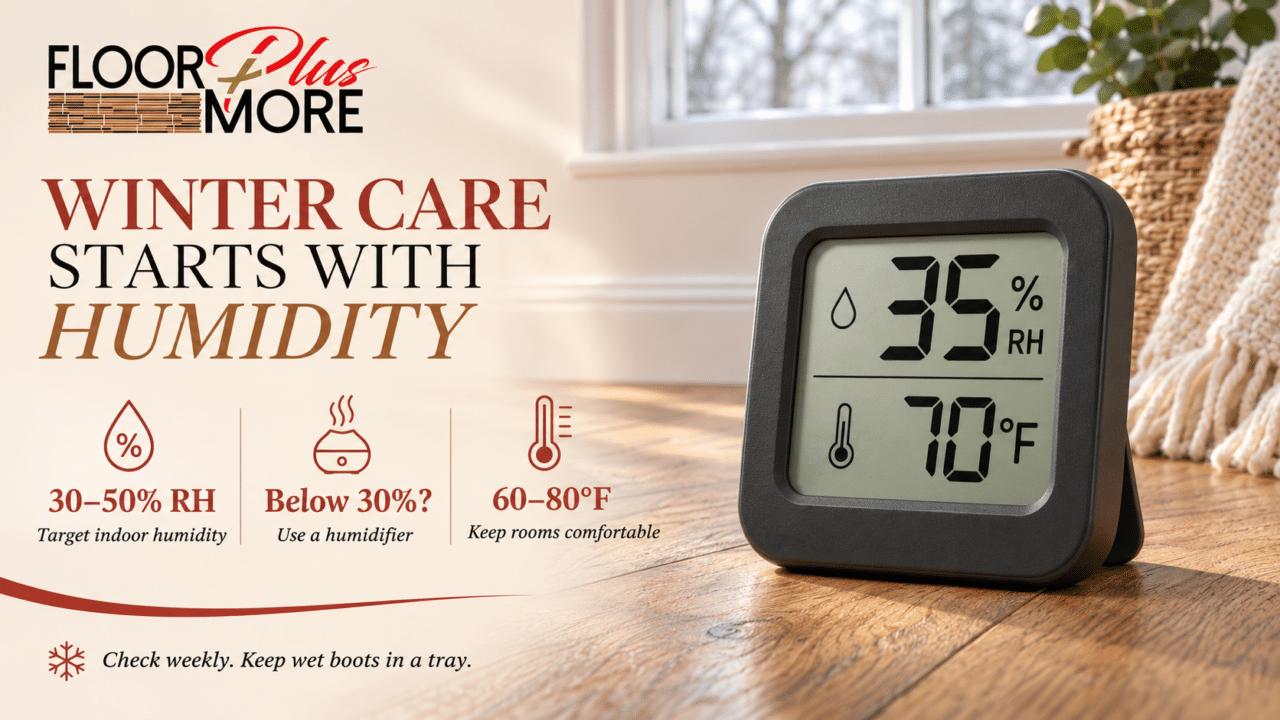
Protect hardwood floors in winter by holding indoor humidity between 30% and 50%, running a humidifier when a hygrometer reads below 30%, keeping rooms at 60 to 80°F, and placing boot trays at entries to catch wet grit and de-icer.
Heating season is the hardest stretch for wood in the Piedmont. Summers in Clemmons, Lewisville, and Advance run sticky, then furnaces pull indoor humidity down and boards shrink, opening seams that trap grit. Homes in low-lying spots near Muddy Creek and in Bermuda Run often swing the widest. Use a simple calendar:
November to March: Read the hygrometer weekly and humidify below 30%.
April to October: Run air conditioning or a dehumidifier above 50%.
The holidays add traffic. Tanglewood Park’s Festival of Lights runs nightly from November 13, 2026 through January 1, 2027, and plenty of Clemmons families host guests before or after the drive. Wet boots and road grit land straight on the floor, so set the boot tray out before the first guest arrives. For the full seasonal plan, read ourhumidity & acclimation guide on how to protect floors in the NC Piedmont.
How Often Should Hardwood Floors Be Recoated?
Figuring out how often to recoat hardwood floors largely depends on the amount of daily foot traffic your rooms experience. As a general rule, most residential spaces require a fresh protective layer roughly every thirty-six to sixty months. If your home is bustling with kids and pets, expect to refresh the finish right around year three, whereas much quieter households can often stretch the timeline closer to year five. Ultimately, the smartest approach is to physically test your finish annually rather than strictly relying on calendar dates.
The Recoat-Readiness Test
Pick three spots: the main walkway, the area in front of the sink, and a protected spot under a rug as your control.
Add a few drops of water to each spot.
Wait 5 minutes, then blot dry.
Read the result. Beads everywhere mean you are fine, so retest next year. Darkening in traffic spots while the control still beads means it is time to recoat. Darkening everywhere, or gray wood showing, means the finish is gone.
If the finish is gone, the floor needs sanding. That is a contractor job, so stop here and call a licensed flooring contractor. Floor Plus More, Inc. does not rent sanders or offer refinishing.
Recoat vs. Sanding
Factor
Maintenance recoat
Needs sanding
Finish condition
Worn but intact
Peeled, bare wood showing
Wood removed
None
About 1/32 inch per pass
Typical timeline
1 to 2 days
Several days
Who handles it
Contractor or experienced homeowner
Licensed flooring contractor
Recoat Prep and Cure Timeline
Deep clean (day before): Dust mop, damp clean, and let the floor dry completely.
Abrade (day 1, 1 to 2 hours): Scuff with the abrasive the finish manufacturer lists, then vacuum and tack the dust.
Apply (day 1, 2 to 4 hours between coats): Roll a thin, even coat with the grain. Hardwood floor maintenance-coat finishes and abrasive pads are on our shelves with ourfloor finishing supplies.
Cure: Allow light foot traffic after about 24 hours, furniture after 48 to 72 hours, and rugs after about 7 days. Always confirm on the product label.
If the floor was ever waxed, tell your contractor first. Wax can stop a new finish from bonding.
Case Study: Two Routines on One 2,400 Sq. Ft. Floor
Picture two homes near Lewisville-Clemmons Road with the same 2,400-square-foot prefinished oak floor. This is hypothetical, but the pattern is common.
Home A steam mops weekly and rinses with vinegar. By year 4, the hallway drops soak in within 90 seconds, a haze dulls the living room, and winter gaps collect grit.
Home B follows basic hardwood floor maintenance: daily dust mopping, a monthly pH-neutral clean, felt pads, and a humidifier holding 35% to 45% in January. At year 4, water still beads in all three test spots, and a contractor applies a maintenance coat in 2 days with no sanding. Same floor, same house style, very different outcomes.
Frequently Asked Questions
1. Is a robot vacuum safe for hardwood floors?
Yes, if it has soft brushes, a hard-floor mode, and no wet-mop attachment. Empty the bin weekly and wipe the wheels monthly, because trapped grit on wheels leaves fine scratches in the finish.
2. How do I remove heel marks and scuffs?
Start by gently buffing the mark with a dry microfiber cloth, then follow up with a cloth moistened with your pH-neutral cleaner. Since these blemishes rest entirely on the surface layer rather than penetrating the wood, about 10 to 15 seconds of light rubbing is usually all it takes to erase them.
3. Should I fill the gaps that open between boards in winter?
No. Seasonal gaps close as humidity rises, and filler can push board edges up in summer. Vacuum the seams with a soft brush attachment and raise indoor humidity toward 35%.
4. What should I do after a water leak?
Mop up standing water immediately, then run fans and a dehumidifier to bring the room under 50% humidity. Mold can start within 24 to 48 hours, so call a flooring professional if boards cup or feel soft.
Beautiful Floors Start with the Right Routine
Consistent hardwood floor maintenance is always more affordable than a full replacement. By building these simple habits into your weekly routine, you guarantee your home stays beautiful for decades. When you need the best supplies to keep that finish shining, Floor Plus More, Inc. is here to help. We proudly serve homeowners and contractors throughout Clemmons, Lewisville, Bermuda Run, Advance, and west Winston-Salem.
Stop by our showroom at 6335 Clementine Drive, located near Idols Road and Hampton Road, Monday to Friday from 7:30 am to 4:30 pm. You can also call us at (336) 999-7113 to ask about our local delivery options. Start your routine with the industry standard and pick up yourBona Floor Care & Finishes today. Trust a local team rated 4.7 stars by your neighbors to help you build the perfect care system.